
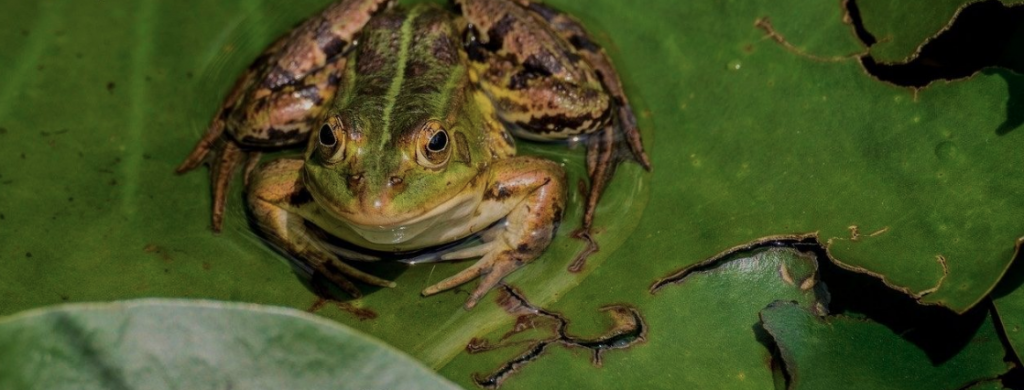
Do you know the green frog? Like all amphibians, it leads a “double life” – amphibious in Greek – between aquatic and terrestrial environments. As a result, the physical characteristics and life cycle of the frog are spectacular! Egg, baby, reproduction, cry, food, etc. With this article, you will know everything about the green frog.
Green frog: how to recognize it?
What is a frog?
The green frog, like the toad and the tree frog, belongs to the group of anurans, those amphibians that do not have a tail in the adult stage.
With other frogs (family Ranidae), it shares certain characteristics:
- horizontal pupils
- eyes rather close together
- a very visible bulge along the back
- long webbed back legs
- a naked skin (without scale), smooth and moist
- a short body
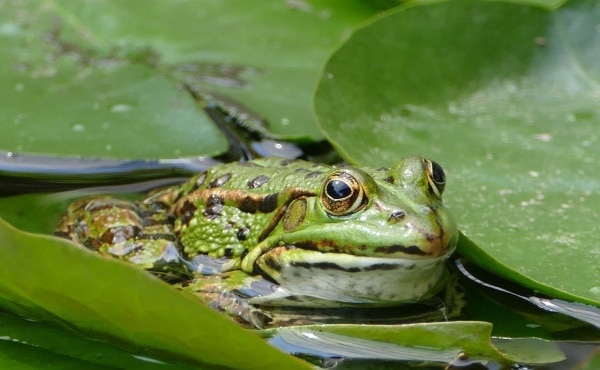
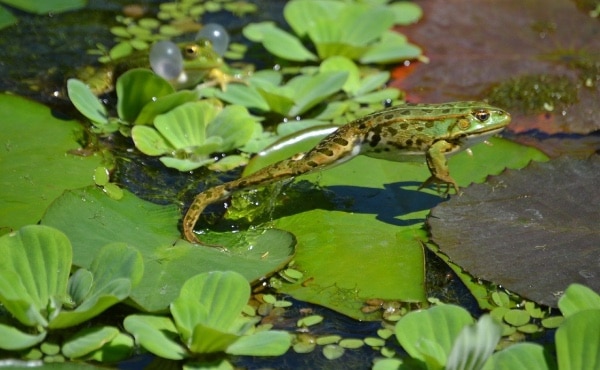
In the United States, there are mainly 3 species of green frogs, from the smallest to the largest:
- the lessona frog, Pelophylax lessonae (about 8 cm)
- the green frog, Pelophylax Kl. esculentus (about 12 cm)
- the laughing frog, Pelophylax ridibundus (about 15 cm)
It is very difficult to identify the different species of green frogs without careful and expert observation, as there are so many variations within the same species.
Vocal bags: an infallible element of differentiation
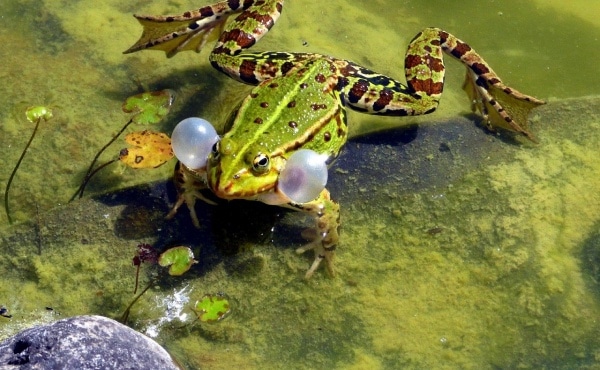
In green frogs, only males have external vocal sacs. These are small balloons located on each side of the mouth. They inflate to amplify the frog’s call – the croak – and its song, which is important during the breeding season. Other frogs often have only one small internal vocal sac under the throat.
Other characteristics also allow recognition of the green frog :
- First, their living environment. Very aquatic, green frogs can be seen in small ponds, ditches, streams, on banks, or in larger waters in rivers or lakes.
- The chant is very specific to the species. So it’s something that connoisseurs use to identify observed animals. You, too, can do this with a little practice, so put your ear to the ground!”
- More subtle, frog dress. Green frogs can wear dorsal colors ranging from green to brown to gray. But almost all wear dark, brown, or black spots.
Incredible powers
Frogs are fascinating animals! From the perspective of us mammals, they have extraordinary powers:
- Frogs are cold-blooded, their bodies do not produce heat but vary with air temperature. To self-regulate, they expose themselves to the sun, or conversely, seek out cool places depending on their needs.
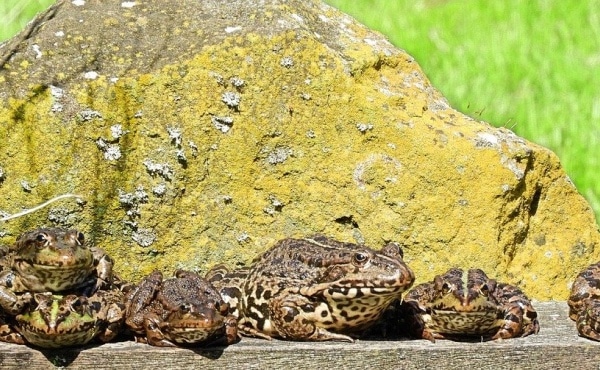
- Some frogs can also withstand a period of freezing during which their vital functions will be suspended and their vital internal organs preserved thanks to a natural “antifreeze”. They can thus come back to life within a few hours after thawing.
- The frog may have lungs, but 80% of its breathing is through the skin.
- To protect themselves from bacteria and fungi, some frogs secrete toxic substances into their skin. Poisonous frogs are thus able to repel their predators.
- To stay hydrated, the frog does not drink water, it is absorbed by its skin.
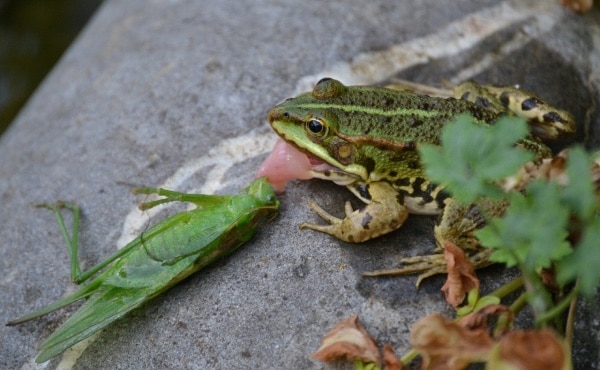
- They have an agile and sticky tongue, about 10 cm long, which allows them to capture their prey and swallow it in one bite.
- Their wide variety of colors and spots ranging from brown to green is a great camouflage technique against predators.
- Thanks to their long muscular back legs, they are able to leap several meters.
Do not Confuse
Green Frog or Brown Frog?
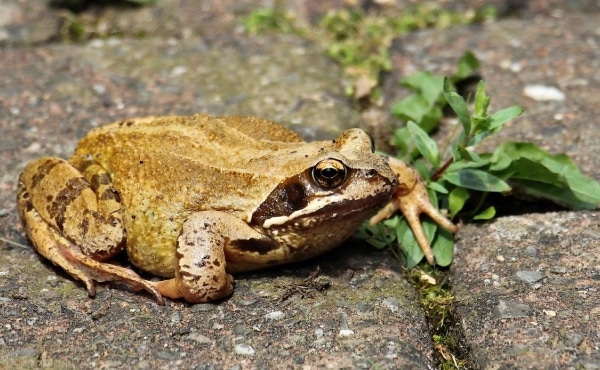
Brown frogs are overall smaller than their green counterparts. They are also more terrestrial and quiet. They have brown skin that can range from red to pink to yellow. Most importantly, they have a brown patch behind the eye that is very characteristic.
The Russian frog (Rana temporaria) is one of the most widespread brown frogs in the United States. Also frequently found in the group of so-called brown frogs are the agile frog (Rana Dalmatia) and the field frog (Rana arvalis).
Toad or Frog?
Do you wonder what the difference is between the toad and the frog?
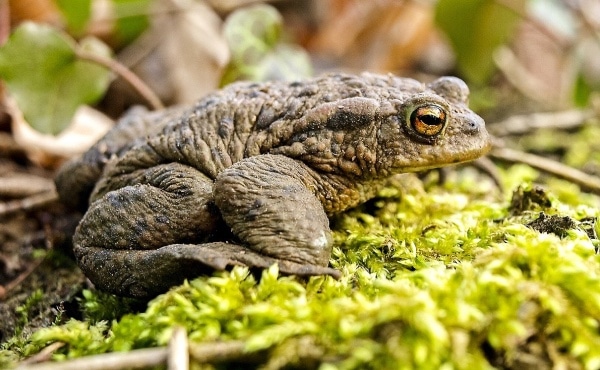
The toad can be distinguished from the frog by its plain skin covered with pustules, its stubbier body, and its shorter legs. It also has a bourrelet at the back of the eyes – the parotid glands – which produce a venom that repels enemies. The toad is terrestrial and moves by walking. It gains wetlands at the time of reproduction: the female lays egg collars, very different from frog eggs.
Treefrog or Frog?
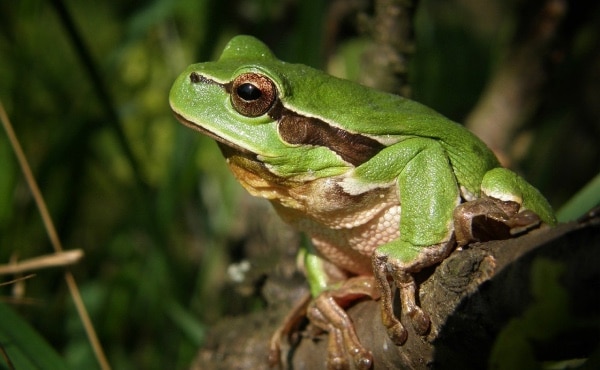
The tree frog is not a frog. Like the frog, its back legs allow it to jump very far. It has smooth and shiny skin, often green with a dark band on both sides. The male has a large vocal sac under the throat to sing very loudly at the time of the reproduction.
Frog: a life punctuated by the seasons
The metamorphosis of the tadpole into a frog
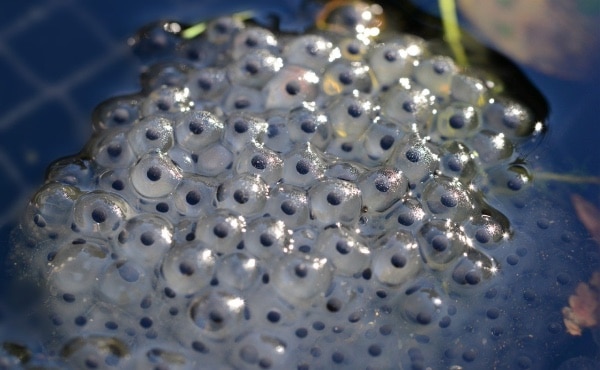
The life cycle of a frog begins at the egg stage. Wrapped in a gelatinous substance that fills with water within 48 hours of being laid, it can float. Then comes the hatching. The frog egg gives birth to an aquatic larva – the tadpole – that breathes through external gills, and through its skin.
First attached to a grass thanks to suction cups, the tadpole feeds on the remains of its egg, before adopting a diet consisting mainly of algae. If, however, food becomes scarce, the tadpole ends up eating its siblings. Groups…
At this stage, the tadpole is a small animal that has a head extended by a body and a tail, like fish. It is then particularly vulnerable, and at the mercy of dragonflies, fish, salamanders and other aquatic insects that enjoy this feast served on a platter. Still, the frog tadpole is equipped with sensory sensors that allow it to spot certain suspicious movements in the water. Group cohesion obliges, in case of danger, it can send ascent into the water that signals to the group an imminent danger, and the need to disperse immediately.
The life rhythm of tadpoles is set to the alternating day and night. During the day, they congregate near the banks at the water’s surface to catch the sun’s heat. At night, they descend to the bottom of the water.
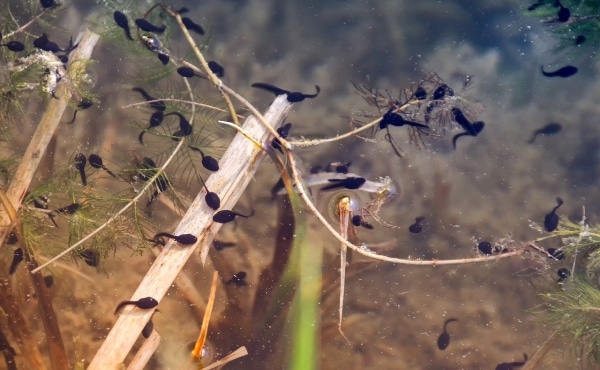
Then comes the day of the metamorphosis. The tadpole, which has grown well, then transforms to become a juvenile, a kind of baby frog. Its tadpole body transforms: the external gills are replaced by internal gills before the lungs appear. Then, its tail which contains a reserve of greases regresses, and leaves the place to the front legs then back. Finally, the head is formed. 2 to 3 months after the metamorphosis, this small green frog leaves the aquatic environment.
It will take 2 to 3 years to reach sexual maturity and the adult stage.
A decade of living to the rhythm of the seasons
The reproduction of the frog
It is in April-May that the green frogs leave their wintering shelter often located at 500 m or even sometimes 1 km from the water point, place of reproduction. They undertake a migration made very risky by the road networks they often have to cross.
The males are the first to arrive at the breeding site from where they sing to attract the females.
The song is characteristic to each species, allowing females to recognize the male of their own species. This is especially useful when a pond is frequented by several species of frogs. The song of the green frog (Pelophylax kl. esculentus) is particularly loud, it can reach 90 decibels. Gregarious species, the males sing in groups, which is why, during the breeding season, they can be heard at great distances.
Sometimes they find a female on the way to the pond and cling to her all the way to the breeding site. The poor thing then has to carry the male on her back, sometimes even several. What an effort! The reproduction of the frog has nothing to do with that of mammals. It takes place as follows:
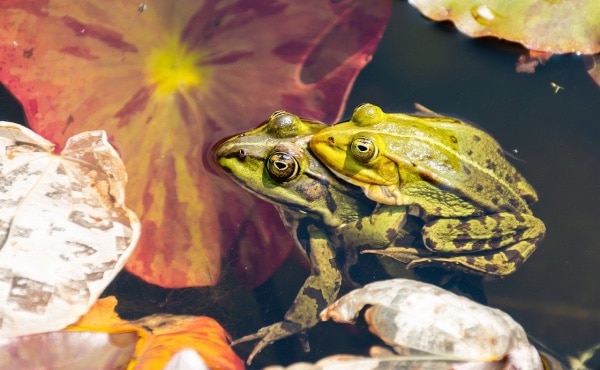
- The amplexus: once in the water, the male embraces the female around the waist or under the arms. Moreover, especially for the breeding period, the male frog develops nuptial calluses: these are rough areas of skin under the fingers, which allow the male to cling more easily to the female.
- Fecundation is external. Females lay eggs, in clusters, and by the thousands – the laughing frog can lay up to 16,000 eggs per season – to maximize the chance of survival of at least a few individuals. The male then comes to cover them with a liquid containing sperm: this is how the eggs are fertilized.
What does a frog eat?
When summer comes, it’s time to stock up for the cold season. While staying near water, frogs move to the land where they can easily hide from foxes, birds, rodents, and snakes, their main predators.
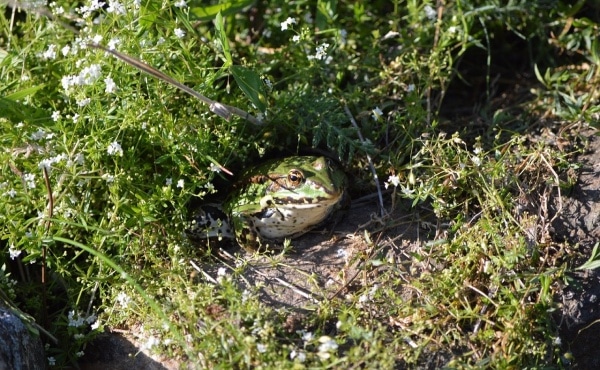
They especially find something to fill their bellies. On the menu: insects, sowbugs, snails, slugs, caterpillars, worms, ants. This diet makes frogs a great help in the permaculture vegetable garden. They protect your crops from being eaten by small invertebrates. If you have a pond, you will see them in action in the morning and at the end of the day. And if you pay attention, you may hear the laughing frog continuing to sing even after the breeding season.
Winterization
When temperatures drop, it is time for the lessons and green frogs to migrate back to their overwintering sites. A hole in the ground, a pile of leaves or stones are good shelters from the frost. During this period, the frog lives in slow motion until next spring. The green frog, on the other hand, overwinters in an aquatic environment where it protects itself from the cold under 40 cm of water.
Thanks to its diet, the green frog is, like the hedgehog and the bat, a true auxiliary that has all its place in a vegetable garden in permaculture. It also needs protection, because the loss and fragmentation of its habitat, as well as pollution, are causing a worrying decline in its population.
Now you know why we’re so keen to create ponds in our vegetable gardens! Does this inspire you? Visit the Frog-Shop.net